


 by webrisor
Lawyer Selection X Artificial Intelligence
Judge-shopping is a legal tactic that has been used by attorneys for a very long time. It essentially consists of manipulating and delaying a case so as to select/avoid judges which are expected to be favorable/unfavorable to one’s cause. Some say it’s a perfectly legitimate strategy, while others call it sneaky and underhanded.
But here’s the thing about judge-shopping: it places the entire focus and responsibility on the presiding judge rather than the acting attorney. The truth is that who your lawyer is may have as much, if not even more, importance as who your judge is. Lawyer selection, however, is still mainly based on recommendations, online reviews and plain ol’ word of mouth. No program had ever been designed to actually quantify a lawyer’s “stats”, for lack of a better term. Until now.
And this is where Premonition could really change the game. It’s essentially an artificial intelligence system that gathers court data to find out which lawyers usually win before which judges. And here’s the kicker: so far, they’ve found no correlation between price and performance! Now obviously Premonition isn’t perfect, and its Chief Innovation Officer, Toby Unwin, has even cautioned that it should be used as the start of a selection process, not as its be-all and end-all. Personally, I think that any program which brings transparency to the legal practice should be welcomed with open arms. Let’s just hope we see something like this in Quebec in the near future!
by webrisorCase of ‘Rude’ Toronto Lawyer Headed to Supreme Court
Lawyers, by nature, are fighters. They’re combative. They’re modern day gladiators, and the courtroom is their arena. This makes sense, given that our criminal justice system is inherently adversarial. It’s one on one combat, minus the gloves and the octagon. So it can’t be too surprising to hear stories of overzealous lawyers defending their clients with fierce conviction and aplomb. Sometimes, however, lawyers forget that they’re actually in a courtroom, where decorum and civility are constantly promoted.
The case of Toronto lawyer Joe Groia, which is now headed to the Supreme Court of Canada, may finally establish a clear distinction between what is and what is not accepted behavior for a lawyer in a courtroom.
Some years ago, Groia was found guilty of incivility for displaying a “consistent pattern of rude, improper or disruptive conduct” in the courtroom during the early part of the trial of his client, former Bre-X Minerals executive John Felderhof. Since then, he’s waged a legal battle with his accusers, the discipline panel of Ontario’s legal regulator. To this day he still maintains that he was simply doing what any good lawyer would do, which is to be an ardent advocate for his client.
Some legal observers say it could be one of the most important Supreme Court rulings for defence lawyers in recent memory.
by webrisorThe Consequences of Impaired Driving Charges in Quebec
Driving under the influence, also known as a DUI or impaired driving, refers to operating a motor vehicle while your ability to drive is impaired by alcohol, drugs or medication.
Legal limits vary by country and province, as do the penalties associated with them. In Canada, the province of Quebec has somewhat unique impaired driving laws, compared to the rest of the country. Which is why it’s important to review them.
There can be many lasting consequences of driving under the influence including fines, license suspension, a criminal record, and even jail time.
If you are convicted of a DUI offence, you will have a criminal record. Criminal records are available online, and via background checks, and can severely impact your livelihood. You may be publicly shamed or humiliated, experience challenges being hired for a job, face problems travelling or crossing the border, and endure lasting stigma around your criminal record.
Fortunately, there are ways to minimize damages associated with a DUI charge, and prevent a conviction. It is important to understand your rights, and it is also crucial that you have an understanding of long-term repercussions, so that you can avoid any potential pitfalls.
Although a DUI is a serious offence, the damage can be limited, and Ginzburg Legal is here to help. In this article we will outline DUI limits for Quebec, what happens if you get charged, and why you should hire a defense lawyer.
What are the DUI limits for Quebec?
In Quebec, the legal limit for blood alcohol content (BAC) is 0.08. That means your blood alcohol concentration is equal to or over 80 mg of alcohol per 100 ml of blood.
If an officer suspects a driver of being drunk, a breathalyzer is administered to measure BAC (different tests are given to measure drug or medication levels). If your BAC is 0.08 or higher, you face DUI charges. If your BAC level is 0.16 or higher, an accident has occurred, or you’re a repeat offender, the charges will be more severe.
There is a zero tolerance policy (0.0 BAC) for drivers on a learners or probationary license, as well as drivers of a bus, taxi or similar.
Remember, refusing a breathalyzer is a criminal offence that automatically results in the stiffest penalties.
But there are also exceptions. In some cases, a driver can be charged if their BAC is lower than 0.08, but the police officer has determined that the driver was exercising poor control.
To make things even more complicated, in certain situations, even if the engine of the car is not switched on, you can still be charged. This is considered care and control of a vehicle, and is penalized because you have the possibility of starting the engine. The following examples can carry the same consequences as impaired driving:
- Sitting in the driver’s seat, even if the vehicle is off
- Being in another seat in the vehicle – ex. Asleep in the passenger or back seat
- Being near the vehicle – ex. Putting things in the trunk
What happens if you get charged with a DUI
If you are convicted of a DUI in Quebec, you face license suspension, loss of demerit points, fines ranging from $300 – $1,750, vehicle impounding, interlocking devices, and jail time. The punishment depends on the severity of the charge.
A first offence includes a license suspension of 90 days and a fine. If your BAC is over 0.16, in addition to this, there will also be a 30-day vehicle impoundment.
Drivers on a learners permit face immediate license suspension for 90 days, a loss of four demerit points, and a fine.
Repeat offenders face tougher penalties, including a jail sentence starting at 30 days. There may also be additional fines, and even the installation of an interlock device on your vehicle.
Something unique to Quebec is that it is one of the few provinces in Canada where a BAC above 0.05, but lower than 0.08 can result in a DUI charge, but not necessarily a license suspension.
Can you be charged for driving while high?
Yes. Just like drinking and driving, drug-impaired driving is also a crime and carries the same penalties. You can be arrested and convicted under the Criminal Code if your driving ability is impaired by drugs or medication, even if you haven’t consumed any alcohol.
This includes cannabis, and you can be charged for driving while high. You can face consequences if you have between 2 and 5 nanograms of THC per ml of blood within two hours of driving.
Why you should hire a DUI Lawyer
Your best defense against driving-related accusations is hiring an experienced criminal defense lawyer who will help to get your charge cleared.
Ginzburg Legal will defend you against every type of driving-related infraction. Our team of legal professionals will help you achieve the best possible legal outcome, which could mean saving your driver’s license or avoiding jail time.
Over 86% of DUI offenses are committed by first-timers, and often these individuals have careers, families, and a lot to lose from having a criminal record. We have significant experience representing first-time offenders, and understand that sometimes people make mistakes. We want to see you move forward with your life as quickly as possible, and aim to create a stress-free environment to best support you.
As your defense lawyers, we offer you a vigorous protection of your rights, through clear and concise legal advice, constant guidance and communication, an empathetic approach, and flexible payment plans. Learn more about what Ginzburg Legal can do for you, and contact us immediately if you’ve been charged with a DUI.
How to get your DUI charge cleared
A DUI can be removed from your permanent record after at least five years (10 years for more serious offences), if certain criteria are met. A record suspension clears all of the details of your charge from the Canadian Police Information Centre database and, for all intents and purposes, you will have a clean record.
Getting a record suspension can take between one and two years, so you should start planning ahead to ensure a successful application process. It is important you do not commit any other offences, and that you have paid all of your fines in full.
At Ginzburg Legal our goal is to handle everything for you, efficiently and discretely, so that you can quickly put this matter behind you and get back to your normal life. We are committed to delivering the best possible outcome, and we take a personal and humanistic approach with every case we handle.
When you choose our team to defend you, you will receive highly-skilled legal representation and ongoing support. No matter how big or small, your case will be treated with importance and given the full attention it deserves.
Before deciding your next move, make sure to consult a criminal lawyer in order to prepare a complete and rigorous defense. Contact Ginzburg Legal in Montreal for a consultation today.
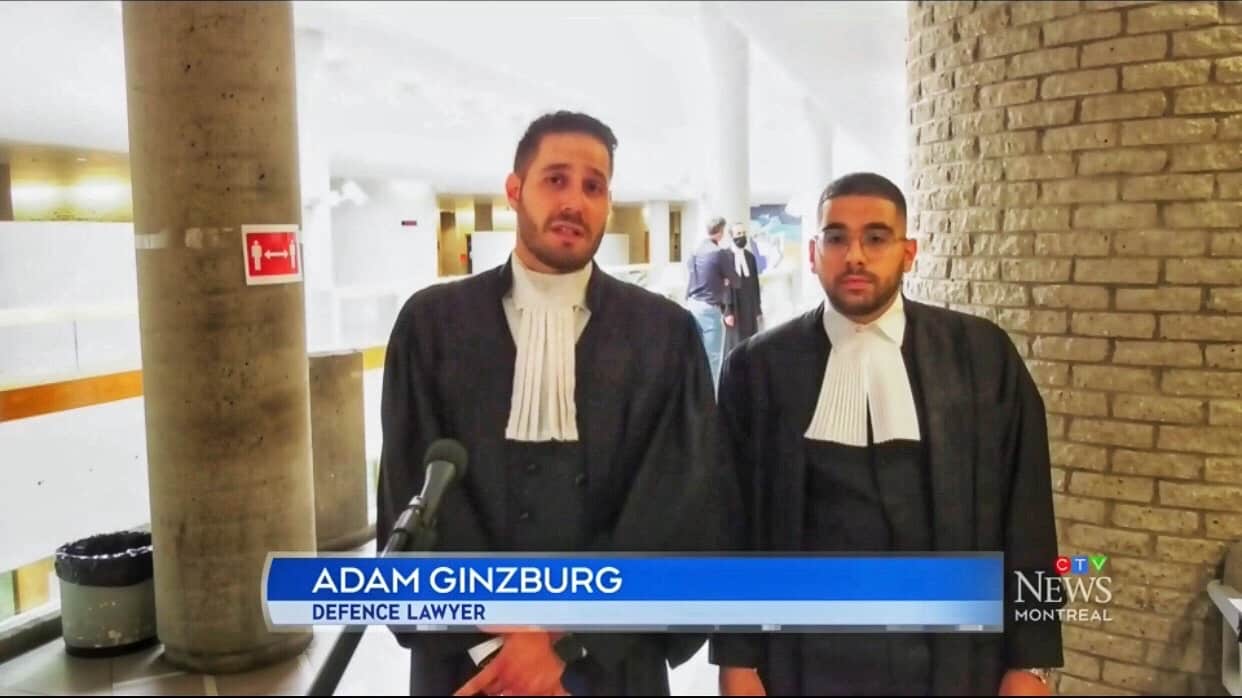 by webrisor
Me Ginzburg appears on CTV News
Following a difficult and emotionally-charged sentencing hearing on a hit and run offence, Me Ginzburg appears on CTV News to speak briefly on the matter. The full article can be found here.
by webrisorArchaic Courts in the Covid Era
It’s no secret that Canadian justice functions on one of the most archaic systems imaginable. It’s 2020, and we live in a glorious era of 5G connectivity, artificial intelligence and virtual reality. And yet, our glorious court system still operates like it did 50 years ago. This may sound like hyperbole, but we’re truly not far away from the days of quill pens and old dusty leather-bound books. It wasn’t so long ago that we heard then Quebec Justice Minister Stéphanie Vallée reveal the government’s plan to overhaul the justice system and allow it to “finally enter the digital era”. But since then not much has actually changed. For a great number of reasons, the legal system, and the legal practice that comes along with it, have been very resistant to technological modernization over the years.
But if there’s any silver lining to be gleaned from this terrible world crisis, it’s perhaps that now, more than ever, our antiquated justice system will be forced into modernity. Indeed, the unprecedented initiative to strictly minimize social contact – which has always been an essential component of procedures in criminal court – has led to some small changes, but more so has cast an embarrassing spotlight on the system’s gross disconnect with modern technology. And this has led to some pretty momentous adaptations.
Here are some of the main technical and logistical issues that have historically plagued the court system. In fairness, some recent initiatives by the Justice department have allowed for long-awaited solutions to some of these issues, but due to years of institutional resistance, many still persist.
Physical presence: Somehow, in the age of simple and accessible video-conferencing, the physical presence of an accused is still required for many steps in criminal court. Despite physical injuries/handicaps, geographical distance, financial limitations or family obligations, our clients are often required to make the trek to court, rain or shine. Before this covid crisis, the idea of a trial via skype was completely unheard of. But some promising news has recently popped up: for the first time ever in a (common law) Quebec tribunal, a trial was held virtually. Lawyers, witnesses and judge were all in separate locations, and each party could be seen and heard via their phones or tablets. This took place on March 26th at the Superior Court of Trois-Rivières before the Honorable judge Clément.
Bailiffs: Bailiffs are tasked with carrying out court orders, which often means handing over official court documents to specific parties. To serve a document means to ensure that said document has officially been brought to the attention of the person concerned. Historically, this has always been done in person, and by paper. Needless to say, this adds to the deluge of paperwork already backlogging the court system. However in a recent ministerial decree, made official on March 27th, Justice Minister Lebel has allowed for the serving of pleadings to now be made via technological means. This is a huge step forward for the justice system.
Court clerks: Court clerks are tasked with taking detailed notes on everything that happens during a hearing. Their role is very important, because without the court minutes we’d have no practical way of confirming/verifying what was said and done during a given court date. And yet, they are still fulfilling these crucial tasks using pen and paper, and occasionally some wite-out to correct a mistake. It’s grossly inefficient for such standardized high-volume tasks to still be performed this way, and it also greatly contributes to the paper-heavy ecological footprint of the court system. One would think it wouldn’t be so hard to set up a computerized system, uploaded with daily dockets and pre-prepared forms for clerks to easily work with. A couple of iPads per courtroom should settle the matter.
Court ushers: Court ushers, in theory, are tasked with ensuring the proper functioning of a court hearing. That could mean anything from directing parties where to be seated, to chastising individuals for not following proper courtroom etiquette. The truth is, all these tasks are generally (and quite promptly) handled by the presiding judge. The most common task of a court usher is to go make photocopies for a judge. Instead of a judge or court clerk simply being able to scan and print copies of a file immediately, our system still requires us to wait for a court usher to slowly make their way through the back channel of the courthouse and find the nearest printer. This inefficiency again could be avoided with the proper technical setup.
One thing is clear: with this crisis upon us, there will be plenty of opportunities for change and adaptation. And this applies on many levels:
- For courts: to be bold and adaptive, to do away with antiquated methods and to keep up with modern times
- For citizens: to have access to simple, intuitive and effective mechanisms to solve their legal disputes
- For lawyers, particularly those from older generations: to be open-minded, to have the courage to change their methods of working, and to embrace the digital age
- For tech/legal entrepreneurs: to realize there has always been a gaping hole in the legal industry for technological innovation. The space is currently empty and it’s up to them to fill it.
If you’ve been convicted of an offence, call Ginzburg Legal in Montreal to speak with a criminal defense lawyer.
Ginzburg Legal
405 Rue Marie-Morin
Montréal QC
H2Y 2Y1
(514) 710-6749
by webrisorCorrectional Facilities in the Covid Era
For most Canadians, correctional centres are like the underside of a couch. We all know they’re there, and we all know they’re probably filled with a number of unsightly problems that need to be addressed, such as accumulating dust/mold/cobwebs, or long-lost items like pens, TV remotes and cat toys. And yet, the vast majority of us prefer to ignore those dark crevasses and just go about our lives. Because it’s easier that way. Because those dark crevasses are out of sight and out of mind.
For a long time, it’s that prejudiced and dismissive way of thinking about correctional facilities that has made it very difficult for anyone – civil rights groups, lawyer associations, politicians – to successfully negotiate better conditions for inmates. It’s no secret: our jails and penitentiaries are overcrowded and unsanitary.
But in the age of a worldwide pandemic such as Covid-19, all of these “out of sight and out of mind” problems are becoming dangerously amplified. In Canada, and across the world, important measures are being taken to limit the impact of the virus on the incarcerated population, as well correctional facilities personnel, and society at large.
The Canadian Civil Liberties Association (CCLA) has recently issued a list of strong recommendations which include:
- Release inmates held in pre-trial custody and therefore presumed innocent by the legal system
- Where it’s not a threat to public safety, release people charged at the scene of an alleged offence instead of bringing them into custody
- Facilitate parole and probation hearings quickly over phone or video-conferencing
- Provide inmates with the option of having virtual visits and programming
- Consider conditional and compassionate releases.
In the words of CCLA executive director Michael Bryant in a letter to Attorney General of Canada David Lametti:
Unlike public health care and emergency funding measures, the criminal justice system in Canada has not seen an intergovernmental, co-ordinated response to flatten the curve of the pandemic [..] In a nutshell, a public health approach would necessitate that the releasable be released; that detention be a measure of last resort.
Here’s a snapshot of recent developments pertaining to how correctional facilities are limiting the spread of Covid-19:
Canada:
- On March 13th, provincial jails temporarily suspended all family visits. Alternatively, all inmates are to receive calling cards in order to contact their loved ones. Additionally, all volunteer and community-based activities, such as AA meetings, have been cancelled. And transfers to and from jails and courthouses will be reduced to an absolute minimum.
- On March 14th, federal penitentiaries followed Quebec’s guidelines and suspended all family visits
- On March 20th, the government temporarily suspended the obligation of discontinued jail time for sentenced individuals. Discontinued jail time allows for a jail term to be served intermittently (usually over weekends) rather than as a long continuous term. It is applicable to sentences of 90 days and under, and individuals with such sentences have the strict obligation to show up at the correctional facilities at specific times. As an alternative, these individuals will now have to spend their weekends at home instead of at the jail, subject to calls and verifications from probation officers. Let’s call it weekend house-arrest.
- On March 20th, Ontario announced it would be releasing some low-risk prisoners early, to reduce the toll of covid-19 on Ontario’s jails.
International:
- On March 16th, Italy adopted a decree that, among other measures, would allow for early supervised release of prisoners with less than 18 months left to serve on their sentence. Patrizio Gonnella, head of Antigone, Italy’s leading prisoner rights organization, estimates the measure could lead to the release of at most 3,000 detainees.
- On March 17th, Los Angeles, home to the largest county jail system in the United States, began actively reducing its jail population and reducing daily police arrests.
- On March 17th, Iran released more than 85,000 prisoners, mostly non-violent offenders serving short prison sentences.
- On March 22nd, the Iowa Department of Corrections announced its plan to expedite the release of about 700 inmates who were already determined eligible for release by the Iowa Board of Parole
- On March 24th, New York State announced the release of vulnerable prisoners, which would include people who were arrested for minor crimes (misdemeanor charges, light sentences of less than a year) and those most vulnerable to infection due to underlying health problems. However mayor De Blasio said he wouldn’t release inmates serving time for domestic violence or sexual assault.
If you’ve been convicted of a crime, call Ginzburg Legal in Montreal to speak with a criminal defense lawyer.
Ginzburg Legal
405 Rue Marie-Morin
Montréal QC
H2Y 2Y1
(514) 710-6749
 by webrisor
Me Ginzburg wins 2018 International Oratory Competition
Me Adam Ginzburg (2nd from right) at the 2018 International Oratory Competition in Louisville, Kentucky. Me Ginzburg was the Canadian representative during the event and managed to win 1st place overall. With the opportunity to compete against some of the best orators from across the U.S, and even some from the U.K, this event was a true test of wit, eloquence and overall oratory excellence. For more on Me Ginzburg’s win, take a look at the Young Montreal Bar’s posted article. Or, contact Ginzburg Legal in Montreal for legal aid.
 by webrisor
US Sues California Over Immigration Laws
A great criminal defense lawyer knows the ins and outs of the legal system, and may be able to spot certain arguments and factors that could mitigate or even negate a potential crime.
by webrisorWhat Does Marijuana Law Mean for You?
If you are looking at prison time or a criminal penalty, it is extremely important to hire a criminal defense lawyer. The legal system is designed and biased so that representing yourself in a criminal trial and expecting a good result is almost impossible.
by webrisorHit-and-Run Crash Suspect Should Seek Immediate Counsel
If you are facing a criminal charge, no matter how minor, you should talk to a defense attorney to fully understand your case. A consultation with an experienced attorney will help you to understand the charges placed against you, the defenses available, what if any plea bargains may be offered to you, and what you should do if you are convicted. We offer free consultations – just contact us. If you are facing a serious charge, however, it is highly recommended that you have a skilled defense attorney represent you in court, and to not attempt self-representation based on a consultation.